 Add to Chrome
 Add to Firefox
 Add to Edge
ST-BCP: Tightening Coverage Bound for Backward Conformal Prediction via Non-Conformity Score Transformation
Feb 02, 2026
Conformal Prediction (CP) provides a statistical framework for uncertainty quantification that constructs prediction sets with coverage guarantees. While CP yields uncontrolled prediction set sizes, Backward Conformal Prediction (BCP) inverts this paradigm by enforcing a predefined upper bound on set size and estimating the resulting coverage guarantee. However, the looseness induced by Markov's inequality within the BCP framework causes a significant gap between the estimated coverage bound and the empirical coverage. In this work, we introduce ST-BCP, a novel method that introduces a data-dependent transformation of nonconformity scores to narrow the coverage gap. In particular, we develop a computable transformation and prove that it outperforms the baseline identity transformation. Extensive experiments demonstrate the effectiveness of our method, reducing the average coverage gap from 4.20\% to 1.12\% on common benchmarks.

Provable Model Provenance Set for Large Language Models
Jan 31, 2026The growing prevalence of unauthorized model usage and misattribution has increased the need for reliable model provenance analysis. However, existing methods largely rely on heuristic fingerprint-matching rules that lack provable error control and often overlook the existence of multiple sources, leaving the reliability of their provenance claims unverified. In this work, we first formalize the model provenance problem with provable guarantees, requiring rigorous coverage of all true provenances at a prescribed confidence level. Then, we propose the Model Provenance Set (MPS), which employs a sequential test-and-exclusion procedure to adaptively construct a small set satisfying the guarantee. The key idea of MPS is to test the significance of provenance existence within a candidate pool, thereby establishing a provable asymptotic guarantee at a user-specific confidence level. Extensive experiments demonstrate that MPS effectively achieves target provenance coverage while strictly limiting the inclusion of unrelated models, and further reveal its potential for practical provenance analysis in attribution and auditing tasks.
Conditional Performance Guarantee for Large Reasoning Models
Jan 30, 2026Large reasoning models have shown strong performance through extended chain-of-thought reasoning, yet their computational cost remains significant. Probably approximately correct (PAC) reasoning provides statistical guarantees for efficient reasoning by adaptively switching between thinking and non-thinking models, but the guarantee holds only in the marginal case and does not provide exact conditional coverage. We propose G-PAC reasoning, a practical framework that provides PAC-style guarantees at the group level by partitioning the input space. We develop two instantiations: Group PAC (G-PAC) reasoning for known group structures and Clustered PAC (C-PAC) reasoning for unknown groupings. We prove that both G-PAC and C-PAC achieve group-conditional risk control, and that grouping can strictly improve efficiency over marginal PAC reasoning in heterogeneous settings. Our experiments on diverse reasoning benchmarks demonstrate that G-PAC and C-PAC successfully achieve group-conditional risk control while maintaining substantial computational savings.
HyPAC: Cost-Efficient LLMs-Human Hybrid Annotation with PAC Error Guarantees
Jan 30, 2026Data annotation often involves multiple sources with different cost-quality trade-offs, such as fast large language models (LLMs), slow reasoning models, and human experts. In this work, we study the problem of routing inputs to the most cost-efficient annotation source while controlling the labeling error on test instances. We propose \textbf{HyPAC}, a method that adaptively labels inputs to the most cost-efficient annotation source while providing distribution-free guarantees on annotation error. HyPAC calibrates two decision thresholds using importance sampling and upper confidence bounds, partitioning inputs into three regions based on uncertainty and routing each to the appropriate annotation source. We prove that HyPAC achieves the minimum expected cost with a probably approximately correct (PAC) guarantee on the annotation error, free of data distribution and pre-trained models. Experiments on common benchmarks demonstrate the effectiveness of our method, reducing the annotation cost by 78.51\% while tightly controlling the annotation error.
Distribution-informed Efficient Conformal Prediction for Full Ranking
Jan 30, 2026Quantifying uncertainty is critical for the safe deployment of ranking models in real-world applications. Recent work offers a rigorous solution using conformal prediction in a full ranking scenario, which aims to construct prediction sets for the absolute ranks of test items based on the relative ranks of calibration items. However, relying on upper bounds of non-conformity scores renders the method overly conservative, resulting in substantially large prediction sets. To address this, we propose Distribution-informed Conformal Ranking (DCR), which produces efficient prediction sets by deriving the exact distribution of non-conformity scores. In particular, we find that the absolute ranks of calibration items follow Negative Hypergeometric distributions, conditional on their relative ranks. DCR thus uses the rank distribution to derive non-conformity score distribution and determine conformal thresholds. We provide theoretical guarantees that DCR achieves improved efficiency over the baseline while ensuring valid coverage under mild assumptions. Extensive experiments demonstrate the superiority of DCR, reducing average prediction set size by up to 36%, while maintaining valid coverage.
Natural Language-Driven Global Mapping of Martian Landforms
Jan 22, 2026Planetary surfaces are typically analyzed using high-level semantic concepts in natural language, yet vast orbital image archives remain organized at the pixel level. This mismatch limits scalable, open-ended exploration of planetary surfaces. Here we present MarScope, a planetary-scale vision-language framework enabling natural language-driven, label-free mapping of Martian landforms. MarScope aligns planetary images and text in a shared semantic space, trained on over 200,000 curated image-text pairs. This framework transforms global geomorphic mapping on Mars by replacing pre-defined classifications with flexible semantic retrieval, enabling arbitrary user queries across the entire planet in 5 seconds with F1 scores up to 0.978. Applications further show that it extends beyond morphological classification to facilitate process-oriented analysis and similarity-based geomorphological mapping at a planetary scale. MarScope establishes a new paradigm where natural language serves as a direct interface for scientific discovery over massive geospatial datasets.
Unlocking the Pre-Trained Model as a Dual-Alignment Calibrator for Post-Trained LLMs
Jan 07, 2026Post-training improves large language models (LLMs) but often worsens confidence calibration, leading to systematic overconfidence. Recent unsupervised post-hoc methods for post-trained LMs (PoLMs) mitigate this by aligning PoLM confidence to that of well-calibrated pre-trained counterparts. However, framing calibration as static output-distribution matching overlooks the inference-time dynamics introduced by post-training. In particular, we show that calibration errors arise from two regimes: (i) confidence drift, where final confidence inflates despite largely consistent intermediate decision processes, and (ii) process drift, where intermediate inference pathways diverge. Guided by this diagnosis, we propose Dual-Align, an unsupervised post-hoc framework for dual alignment in confidence calibration. Dual-Align performs confidence alignment to correct confidence drift via final-distribution matching, and introduces process alignment to address process drift by locating the layer where trajectories diverge and realigning the stability of subsequent inference. This dual strategy learns a single temperature parameter that corrects both drift types without sacrificing post-training performance gains. Experiments show consistent improvements over baselines, reducing calibration errors and approaching a supervised oracle.
Multi-Condition Conformal Selection
Oct 09, 2025
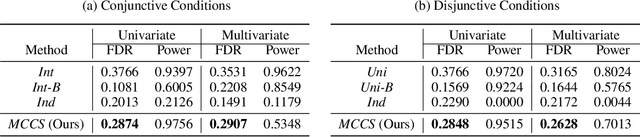

Selecting high-quality candidates from large-scale datasets is critically important in resource-constrained applications such as drug discovery, precision medicine, and the alignment of large language models. While conformal selection methods offer a rigorous solution with False Discovery Rate (FDR) control, their applicability is confined to single-threshold scenarios (i.e., y > c) and overlooks practical needs for multi-condition selection, such as conjunctive or disjunctive conditions. In this work, we propose the Multi-Condition Conformal Selection (MCCS) algorithm, which extends conformal selection to scenarios with multiple conditions. In particular, we introduce a novel nonconformity score with regional monotonicity for conjunctive conditions and a global Benjamini-Hochberg (BH) procedure for disjunctive conditions, thereby establishing finite-sample FDR control with theoretical guarantees. The integration of these components enables the proposed method to achieve rigorous FDR-controlled selection in various multi-condition environments. Extensive experiments validate the superiority of MCCS over baselines, its generalizability across diverse condition combinations, different real-world modalities, and multi-task scalability.
Detecting Distillation Data from Reasoning Models
Oct 06, 2025Reasoning distillation has emerged as an efficient and powerful paradigm for enhancing the reasoning capabilities of large language models. However, reasoning distillation may inadvertently cause benchmark contamination, where evaluation data included in distillation datasets can inflate performance metrics of distilled models. In this work, we formally define the task of distillation data detection, which is uniquely challenging due to the partial availability of distillation data. Then, we propose a novel and effective method Token Probability Deviation (TBD), which leverages the probability patterns of the generated output tokens. Our method is motivated by the analysis that distilled models tend to generate near-deterministic tokens for seen questions, while producing more low-probability tokens for unseen questions. Our key idea behind TBD is to quantify how far the generated tokens' probabilities deviate from a high reference probability. In effect, our method achieves competitive detection performance by producing lower scores for seen questions than for unseen questions. Extensive experiments demonstrate the effectiveness of our method, achieving an AUC of 0.918 and a TPR@1% FPR of 0.470 on the S1 dataset.
Semi-Supervised Conformal Prediction With Unlabeled Nonconformity Score
May 27, 2025Conformal prediction (CP) is a powerful framework for uncertainty quantification, providing prediction sets with coverage guarantees when calibrated on sufficient labeled data. However, in real-world applications where labeled data is often limited, standard CP can lead to coverage deviation and output overly large prediction sets. In this paper, we extend CP to the semi-supervised setting and propose SemiCP, leveraging both labeled data and unlabeled data for calibration. Specifically, we introduce a novel nonconformity score function, NNM, designed for unlabeled data. This function selects labeled data with similar pseudo-label scores to estimate nonconformity scores, integrating them into the calibration process to overcome sample size limitations. We theoretically demonstrate that, under mild assumptions, SemiCP provide asymptotically coverage guarantee for prediction sets. Extensive experiments further validate that our approach effectively reduces instability and inefficiency under limited calibration data, can be adapted to conditional coverage settings, and integrates seamlessly with existing CP methods.